
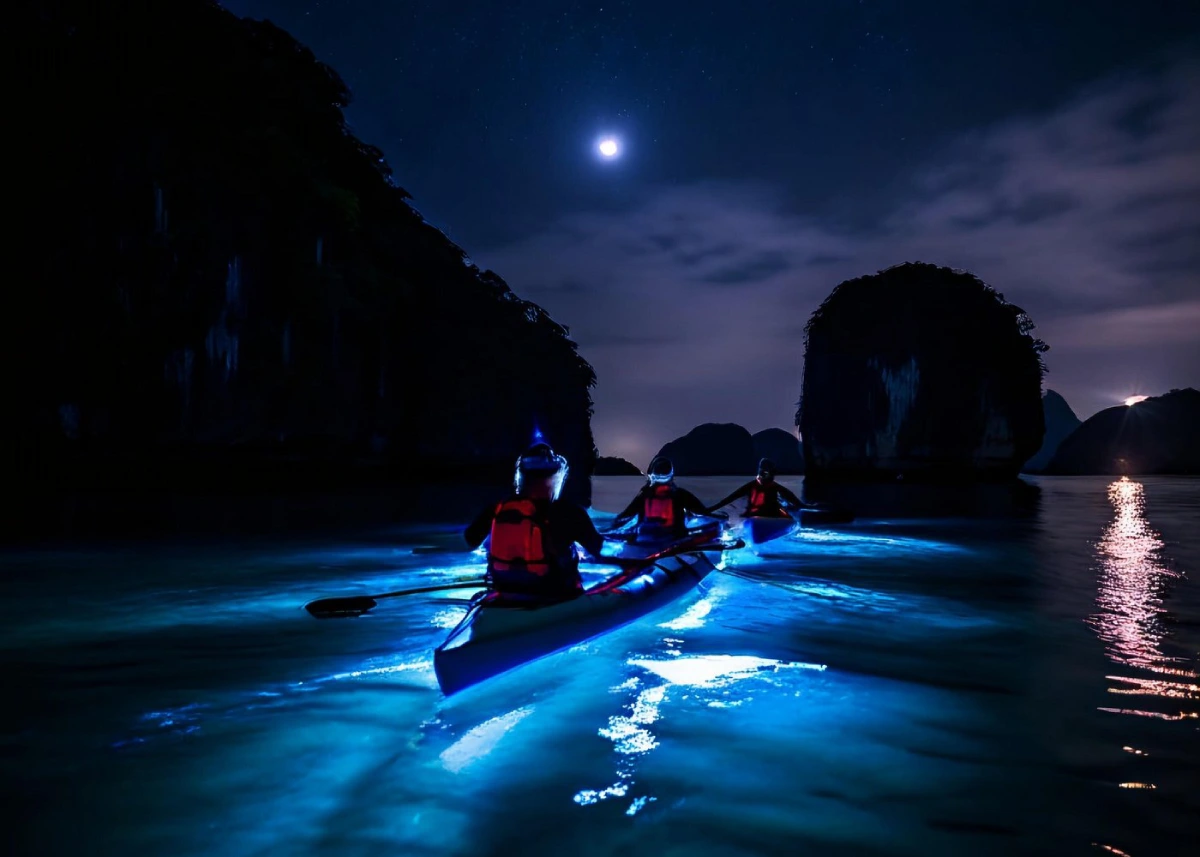
Every year, thousands of travelers brave freezing temperatures and long, expensive journeys to the Arctic Circle, chasing one of the planet’s most famous spectacles: the northern lights. But what if one of the world’s most breathtaking natural light shows did not require a parka, a fortune, or a flight to Iceland — and was glowing quietly in the warm waters of northern Vietnam?
Meet bioluminescent plankton: the sea’s answer to the aurora. In the sheltered lagoons of Lan Ha Bay, the water itself lights up in streaks of electric blue with every paddle stroke. It is, quite simply, one of the most underrated natural wonders in Southeast Asia. In this guide, we put the two phenomena head-to-head — what causes them, where and when to see them, and why Vietnam’s glowing sea deserves a spot on your bucket list.
Two of Nature’s Greatest Light Shows
The northern lights and bioluminescent plankton could not be more different in origin, yet they stir the same sense of wonder. One paints the sky; the other lights the sea. One belongs to the frozen poles; the other thrives in tropical warmth. Both make you feel, for a moment, like you are looking at something not entirely of this world.
What Are the Northern Lights?
The aurora borealis appears when charged particles from the sun collide with gases in Earth’s upper atmosphere, producing rippling curtains of green, pink, and violet light. It is visible mainly at high latitudes — places like Norway, Iceland, Finland, Canada, and Alaska — and usually in the depths of winter, when nights are longest and darkest. Seeing it well often means cold-weather gear, multiple nights of patient waiting, and a fair amount of luck with the weather and solar activity.
What Is Bioluminescent Plankton?
Bioluminescent plankton are microscopic marine organisms that emit light when the water around them is disturbed. Paddle a kayak, trail your hand, or watch a fish dart past, and the movement triggers a glowing burst of blue-green light. Unlike the aurora, this is a phenomenon you can touch and play with — the sea sparkles wherever you move it. For the full science and timing, see our complete guide to bioluminescent plankton in Lan Ha Bay.
Bioluminescent Plankton vs Northern Lights: Head-to-Head
Here is how the two natural wonders compare across the factors that matter most to travelers:
| Factor | Northern Lights | Bioluminescent Plankton |
|---|---|---|
| What causes it | Solar particles hitting the atmosphere | Marine plankton glowing when disturbed |
| Where | Arctic latitudes (Iceland, Norway, etc.) | Warm, dark bays such as Lan Ha Bay, Vietnam |
| Best season | Winter (cold, long nights) | Warm months, roughly May–November |
| Climate | Freezing, cold-weather gear needed | Tropical and warm — swimwear weather |
| Cost to reach | Often high (flights, tours, hotels) | Affordable, especially within a Vietnam trip |
| How you see it | Look up and wait | Paddle, swim, touch the glowing water |
| Predictability | Variable; depends on solar activity | Variable; best on dark, calm, warm nights |
Why the Plankton Might Be the Better Trip
The northern lights are unforgettable, and no one is suggesting you skip them. But for many travelers, Vietnam’s glowing sea offers a surprisingly compelling alternative — and a few clear advantages:
- Warm instead of freezing. You can experience it in shorts and a t-shirt, even swim in it, rather than shivering under the Arctic sky.
- Far more affordable. Reaching prime aurora territory can cost a small fortune. The plankton sits inside one of Asia’s best-value destinations.
- Interactive, not just observed. You do not stand and wait — you paddle through it and make the light yourself.
- Crowd-free. Aurora hotspots can get busy. Lan Ha Bay’s quiet lagoons often feel like your own private show.
- Pairs with a full trip. The glow is one highlight of a region packed with karst scenery, beaches, and culture.
Where to See Vietnam’s Glowing Sea: Lan Ha Bay
Vietnam’s best-known stage for bioluminescence is Lan Ha Bay, just south of Ha Long Bay within the Cat Ba Archipelago. While Ha Long pulls the big crowds, Lan Ha stays quieter, cleaner, and darker at night — and darkness is everything for spotting the glow. Hundreds of forested karst islands shelter calm, enclosed lagoons that create the still, light-free conditions the plankton needs to shine.
If you are weighing up which bay to base yourself in, our comparison of Lan Ha Bay versus Ha Long Bay explains why Lan Ha consistently wins for after-dark experiences. And if you are still deciding whether the region is worth the detour at all, here is our honest take on whether Cat Ba is worth visiting.
Best Time and Conditions to See It
Just like chasing the aurora, success comes down to timing the right conditions. Three factors decide your night:
- Season. The plankton is most active from May to November, with the brightest displays usually between June and October. Winter sightings are far rarer.
- Moon phase. Plankton light is faint, so bright moonlight washes it out. Aim for a new moon or a heavily clouded sky.
- Time and water. Go after dark — ideally between 8:00 and 10:00 pm — on calm water. Lan Ha’s sheltered lagoons are perfect.
How to Experience It for Yourself
The easiest and most reliable way to see Vietnam’s glowing sea is on an overnight cruise that puts you in the bay during the dark hours when the plankton peaks. Evening-only trips work, but day-trippers have to leave just as the bay reaches its most magical. Staying overnight gives you the lagoon almost to yourself.
Our Lan Ha Bay 2 Days 1 Night cruise with night kayaking and bioluminescent plankton is built around exactly this experience: a sunset on the water, dinner on board, guided night paddling through the glowing lagoon, and a peaceful morning before the day boats arrive. It is the closest thing to an aurora hunt you will find in the tropics — minus the cold and the airfare.
Which Wonder Is Right for You?
If your dream is sweeping curtains of color across a frozen sky, the northern lights remain in a class of their own. But if you want a warm-weather, hands-on, budget-friendly spectacle that most travelers have never even heard of, Vietnam’s bioluminescent plankton is one of the most rewarding natural wonders you can chase. Better still, you do not have to choose between bucket-list status and accessibility — here, you get both.
Frequently Asked Questions
Is bioluminescent plankton as impressive as the northern lights?
They are different experiences. The aurora is a vast sky display you watch, while the plankton is an intimate, interactive glow you paddle and swim through. Many travelers find the plankton just as magical — and far more accessible.
Can you see bioluminescent plankton in Vietnam year-round?
It is most reliable in the warm season (roughly May to November), on dark, calm nights around the new moon. Winter sightings are much rarer.
Where is the best place to see it in Vietnam?
Lan Ha Bay, near Cat Ba Island, is the top spot thanks to its dark, sheltered, and clean lagoons.
Do I need any experience to see the plankton?
No. On a guided night kayaking trip, the calm lagoons are beginner-friendly and suitable for first-timers.
See Vietnam’s Light Show for Yourself
The northern lights may get all the fame, but Vietnam’s glowing sea is the underrated wonder worth planning a trip around — warm, affordable, interactive, and unforgettable. Pick a dark night in the warm season, head to Lan Ha Bay, and let the water light up around you. The simplest way to make it happen is to book a 2 Days 1 Night Lan Ha Bay cruise and paddle straight into the glow.


Comment (0)